


Guest posting services for small businesses are the difference between staying invisible and actually getting found online.
Look, we get it.
You’re running a small business. You’ve got 47 things on your to-do list. Your marketing budget isn’t exactly Amazon’s. And every “SEO expert” wants $5,000 a month just to “get started.”
Here’s the thing – most small businesses think guest posting is some mystical art form only big agencies can crack.
That’s rubbish.
I’ve seen tiny startups outrank massive corporations using nothing but strategic guest posting. The difference? They knew which levers to pull.
Why Small Businesses Actually Have a Guest Posting Advantage
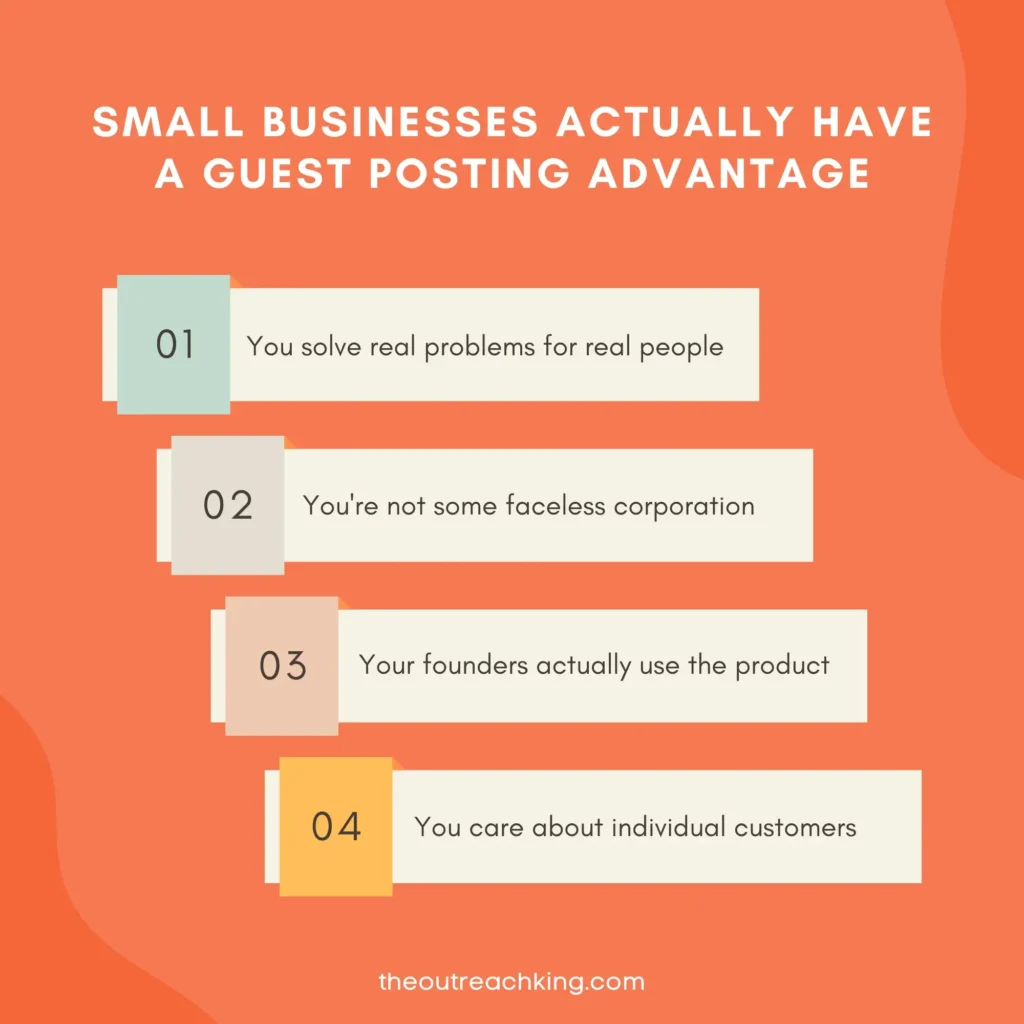
Small businesses have one genuine edge in guest posting that agencies and big brands can’t replicate: a real founder with a real story.
Editors commission content for their readers, not for the writer’s brand. What gets accepted is angles that feel human, specific, and lived-in. A founder who bootstrapped a business, lost a client, changed direction, and figured something out has that naturally. A corporate marketing team writing on behalf of a brand does not.
That’s not a small advantage. Most publications are drowning in polished, personality-free pitches. A specific story from someone who actually runs a business cuts through that noise immediately.
The businesses that struggle with guest posting aren’t struggling because they’re small. They’re struggling because they’re pitching like they’re big.
Wrong mindset entirely.
The Real Problem Small Businesses Face with Guest Posting
After analysing hundreds of small business websites, here are the actual issues:
1. They Think It’s About Volume
Most small businesses see guest posting as a numbers game. Get 50 low-quality backlinks. Hope Google notices. Wonder why their rankings don’t budge.
The truth: One high-authority, niche-relevant placement beats 20 random blog posts.
2. They Target the Wrong Sites
Small businesses often pitch anyone who’ll listen. Food blog for a SaaS company? Sure, why not. Travel site for accounting software? Brilliant strategy.
The reality: Niche relevance trumps domain authority every single time.
3. They Write Boring Content
Most small business guest posts read like instruction manuals. No personality. No stories. No reason for anyone to care.
The fix: Write like you’re explaining your product to your mum over Sunday dinner.
Tired of watching competitors rank higher while your amazing product stays invisible?
Let’s fix that.
Book a free 15-minute strategy call to see which guest posting
opportunities could transform your business.
What Actually Works: Blueprint For Guest Posting Services for Small Businesses
Phase 1: Foundation Building (Week 1-2)
Before you pitch anyone, get this sorted:
- Nail your value proposition – What problem do you solve that others don’t?
- Document your wins – Customer stories, case studies, actual results
- Build your expertise markers – Industry certifications, founder background, unique insights
Phase 2: Strategic Site Research (Week 3)
Don’t just Google “write for us” + your industry.
Here’s the proper approach:
- Find where your customers actually hang out online
- Industry forums
- LinkedIn groups
- Reddit communities
- Industry newsletters
- Identify the publications they read
- What sites do they share articles from?
- Which blogs get mentioned in discussions?
- Where do industry leaders publish?
- Analyse the metrics that matter
- Organic traffic (use Ahrefs or SEMrush)
- Domain authority (40+ is ideal)
- Audience engagement (comments, shares, actual discussion)
- Content quality (do they publish rubbish or gold?)
Phase 3: The Outreach That Actually Gets Responses
Stop sending templates that scream “mass email.”
Here’s what works:
The 3-Touch Approach
Email 1: The Soft Introduction
Subject: Quick thought on [specific recent article title]

Hi [Name],

Just read your piece on [specific topic]. The bit about [specific detail] really resonated - we've seen exactly that with our [customer type] clients.

Got a similar story from the other side that might interest your readers. Worth a quick chat?

Best,
[Your name]

P.S. - Loved the [specific example/quote from their content]. Spot on.
Email 2: The Value Add (1 week later) Share something useful. No ask. Just value. Industry insight, helpful resource, or relevant case study.
Email 3: The Specific Pitch (1 week later) Now, you make your actual proposal with a specific angle.
Phase 4: Content That Converts
Your guest post isn’t about you. It’s for their audience.
The Formula That Works:
- Hook with a problem they recognise
- “Every [target customer type] I meet makes this same mistake…”
- “The biggest lie in [industry] is…”
- “Here’s what [customer type] gets wrong about [topic]…”
- Share your solution through a story
- Don’t lecture. Tell stories.
- Use real examples from your business.
- Show the before/after transformation.
- Give away your best insights
- Don’t hold back your “secret sauce”
- The more value you provide, the more authority you build
- Trust builds sales, not secrecy
- End with a soft CTA
- Not “Buy my product”
- More like “If you’re facing [specific challenge], here’s a resource that helps”
Advanced Strategies: What The Big Players Don’t Want You to Know
The Niche Domination Approach
Instead of spreading thin across 50 sites, dominate 5-10 key publications in your industry.
Here’s how:
- Publish consistently on these sites (monthly minimum)
- Become a recognisable name in their community
- Build relationships with their editorial teams
- Eventually become their go-to expert for your topic
The Customer Journey Mapping Strategy
Most businesses target awareness-stage content.
Smart businesses map content to the entire customer journey:
- Awareness: “Why [problem] happens and what to do about it”
- Consideration: “How to choose the right [solution category]”
- Decision: “What to look for when comparing [specific tools]”
- Retention: “Advanced strategies for [existing users]”
The Authority Building Sequence
Don’t just get one placement and disappear. Build a sequence:
- Month 1: Industry overview piece (establishes you know the landscape)
- Month 2: Tactical how-to guide (shows you can execute)
- Month 3: Case study or results piece (proves you get results)
- Month 4: Future trends or predictions (positions you as a thought leader)
Want to see exactly how we’ve helped 200+ small businesses dominate their niches
using these exact strategies?
Check out our case studies and client results.
Affordable Guest Post Outreach Packages: What to Look For
The market’s full of cheap guest posting services. Most are rubbish.
Here’s how to spot the good ones:
Red Flags to Avoid:
- Prices under $30 per post (you get what you pay for)
- Guaranteed DA numbers without showing the actual sites
- “1000 backlinks for $500” offers (spam farm alert)
- No content creation included (you want full service)
- Instant delivery promises (real outreach takes time)
What Good Packages Include:
- Site research and vetting (they should find relevant opportunities)
- Content creation (500-1000 words minimum)
- Outreach and relationship building (not just email blasts)
- Reporting and tracking (you need to see results)
- Lifetime link guarantee (links should stay live)
Pricing Reality Check:
Based on 2026 market analysis:
- Basic packages: $80-150 per placement (DA 20-40)
- Standard packages: $150-300 per placement (DA 40-60)
- Premium packages: $300-600 per placement (DA 60+)
My recommendation: Start with 3-5 standard placements rather than 20 basic ones.
Skip the guesswork. Download our free “Guest Posting Site Evaluation Checklist“
the same 47-point checklist our team uses to vet every opportunity.
White Hat Guest Posting Service Provider: Why This Matters More in 2026
Google’s getting smarter. The penalties are getting nastier.
After the August 2026 algorithm updates, here’s what “white hat” actually means:
Non-Negotiable Requirements:
- Real editorial oversight (someone actually reads and approves content)
- Genuine publisher relationships (not just contact form spam)
- Natural, contextual link placement (no author bio link stuffing)
- Relevant content for the audience (not keyword-stuffed rubbish)
- Transparent reporting (you should see exactly where links are placed)
Questions to Ask Potential Providers:
- “Can you show me examples of sites you’ve placed content on?”
- They should have a portfolio you can verify
- “What’s your content approval process?”
- Good providers have editorial review stages
- “How do you handle link placement?”
- Red flag if they mention author bios as the primary strategy
- “What guarantees do you provide?”
- Lifetime link guarantees are standard now
- “Can you show me your outreach templates?”
- Templates are fine, but they should be personalised
Niche Relevant Guest Posting Opportunities: The Secret Sauce
Most businesses think “relevant” means the same industry. That’s thinking too small.
The Concentric Circles Approach:
Circle 1: Direct Industry Your immediate competitors’ audience. Highest relevance, but also hardest to crack.
Circle 2: Adjacent Industries Industries that serve the same customers. Example: If you sell project management software, target productivity blogs, remote work sites, and business efficiency publications.
Circle 3: Customer Interest Areas What else do your customers care about? Example: SaaS founders read about fundraising, leadership, and startup culture.
Circle 4: Problem-Adjacent Topics What problems exist alongside the one you solve? Example: If you do accounting software, your customers also worry about cash flow, business growth, and tax planning.
Industry-Specific Opportunity Mapping:
For SaaS Companies:
- Tech publications (TechCrunch, VentureBeat)
- Business productivity sites (Zapier blog, Notion resources)
- Industry-specific trade publications (vertical SaaS opportunities)
- Startup ecosystem blogs (First Round Review, NFX)
For Local Service Businesses:
- Local business journals (chamber of commerce publications)
- Industry association sites (plumbing associations, legal societies)
- Local lifestyle blogs (city-specific publications)
- Regional business publications (local newspapers’ business sections)
For E-commerce Brands:
- Industry trade publications (depending on your product category)
- E-commerce education sites (Shopify blog, BigCommerce resources)
- Consumer lifestyle sites (relevant to your product category)
- Influencer partnerships (micro-influencers in your niche)
Advanced Tactics: The Outreach King Approach
At The Outreach King, we follow a strategy. Here are the tactics that separate pros from amateurs:
The Relationship-First Strategy
Comments that get noticed do one of three things: add a data point the article missed, respectfully push back with a reason, or share a specific experience that extends the author’s point. “Great article!” gets ignored. Specific engagement gets remembered.
Run the warm-up for three to four weeks before pitching. One comment a week on their content. One genuine share with a sentence explaining why. One LinkedIn connection referencing something specific they wrote.
The transparent warm-up editors see through immediately: three suspiciously positive comments in one week, followed by a pitch. The pattern is obvious because it’s rushed. Slowness is what makes it credible.
The Editorial Calendar Alignment
Most publications don’t share their calendar publicly. You can reverse-engineer it.
Go through their last twelve months and find the patterns. Prediction pieces every December? Beginner guides every January? Most publications are more predictable than they realise.
Once you spot an upcoming window, pitch four to six weeks before they need it. Then reference the pattern directly: “I noticed you typically cover X heading into Q4, I have an angle your readers haven’t seen yet.” That one line signals you’ve done your homework and makes the editor’s job easier.
The Multi-Touch Campaign
The sequence matters because each format does a different job.
Comments and shares first, establish that you exist and pay attention. A message second, introduce yourself and offer something useful with no ask. The pitch third, by now you’re a recognisable name, not a stranger.
Keep the sequence on one platform where possible. An editor who sees your comment, then your LinkedIn message, then your email has a clear thread. An editor who gets a tweet, an Instagram comment, and then an email just feels followed.
Common Mistakes Small Businesses Make (And How to Avoid Them)
Mistake 1: The Spray and Pray Approach
What they do: Send the same pitch to 100 websites. Why it fails: Generic pitches get ignored. The fix: Personalise every outreach (limit to 10-15 quality prospects per week)
Mistake 2: The Cheap and Cheerful Strategy
What they do: Choose the cheapest service available. Why it fails: You get low-quality sites and spammy links. The fix: Invest in 5 quality placements rather than 50 cheap ones
Mistake 3: The Set-and-Forget Mentality
What they do: Get a few guest posts and expect magic. Why it fails: SEO takes time and consistency. The fix: Plan for 6-12 months of consistent guest posting activity
Mistake 4: The Sales-Heavy Content
What they do: Write guest posts that are barely disguised sales pitches. Why it fails: Editors reject promotional content. The fix: Provide genuine value first, subtle promotion second
Tools and Resources for DIY Guest Posting
Essential Tools:
- Ahrefs/SEMrush (for site research and competitor analysis)
- Hunter.io (for finding editor email addresses)
- Pitchbox or BuzzStream (for outreach management)
- Google Alerts (for finding content opportunities)
- HARO (Help a Reporter Out) (for earned media opportunities)
Free Resources:
- Google Search Operators (site:example.com “write for us”)
- Twitter Advanced Search (finding editors and opportunities)
- LinkedIn Sales Navigator (free trial for finding decision-makers)
- Industry Facebook Groups (networking and opportunity sharing)
Want our complete outreach email templates that get 67% response rates?
Plus our publisher database of 500+ vetted sites.
Measuring Success: Metrics That Actually Matter
Vanity Metrics (Ignore These):
- Number of backlinks acquired
- Domain authority of linking sites
- Number of articles published
Success Metrics (Track These):
- Organic traffic growth (from target keywords)
- Rankings improvement (for money keywords)
- Referral traffic quality (time on site, conversion rate)
- Brand mention increase (unlinked brand mentions)
- Pipeline attribution (leads/sales from guest post traffic)
Monthly Reporting Template:
- Links acquired (with DA/traffic stats)
- Content published (with engagement metrics)
- Traffic impact (organic + referral)
- Ranking changes (for target keywords)
- Lead attribution (if trackable)
Budget Planning: What Small Businesses Should Actually Spend
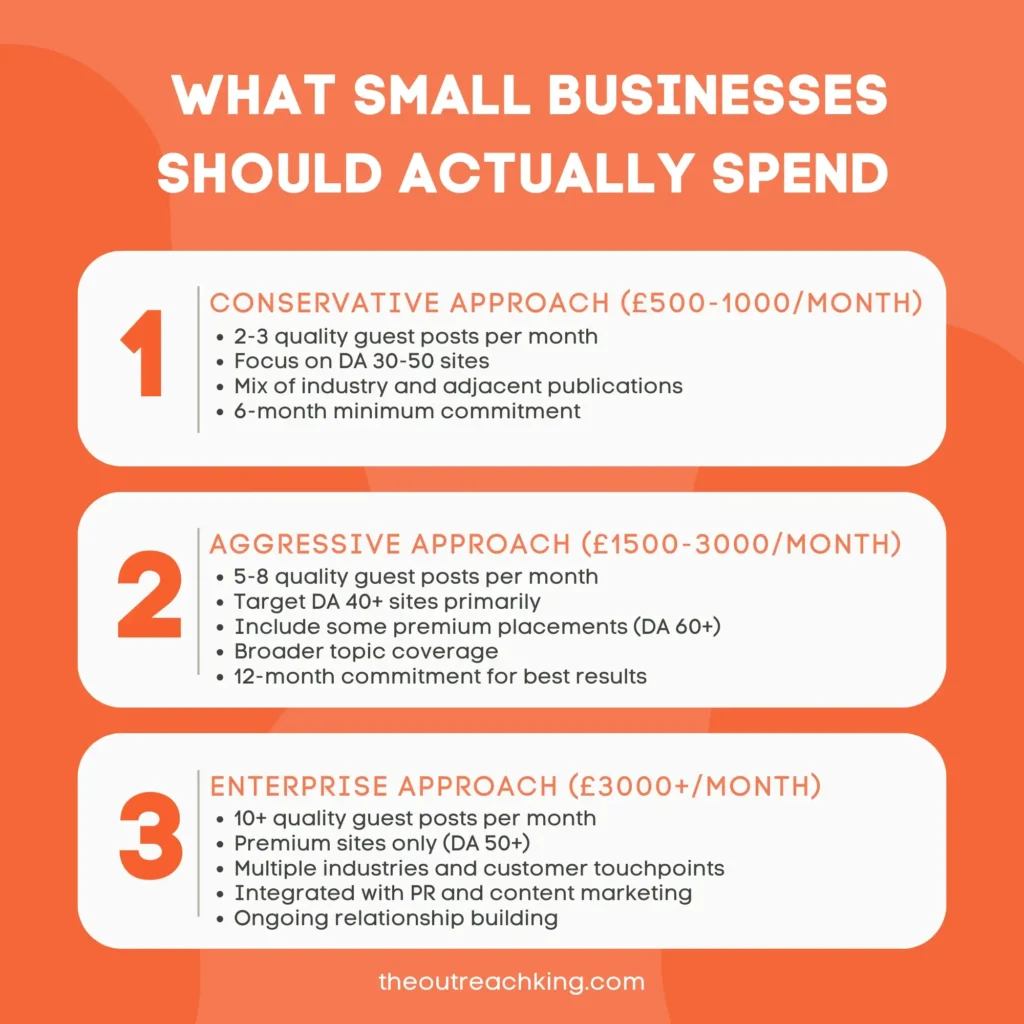
Conservative Approach ($500-1000/month):
2-3 quality guest posts per month
- Focus on DA 30-50 sites
- Mix of industry and adjacent publications
- 6-month minimum commitment
Aggressive Approach ($1500-3000/month):
- 5-8 quality guest posts per month
- Target DA 40+ sites primarily
- Include some premium placements (DA 60+)
- Broader topic coverage
- 12-month commitment for best results
Enterprise Approach ($3000+/month):
- 10+ quality guest posts per month
- Premium sites only (DA 50+)
- Multiple industries and customer touchpoints
- Integrated with PR and content marketing
- Ongoing relationship building
We only work with 15 new small businesses per quarter to ensure quality results.
Working with Guest Posting Services: A Buyer’s Guide
Questions to Ask Before Hiring:
- “Can you show me your actual publisher network?”
- They should provide examples (not just promises)
- “What’s your average turnaround time?”
- Realistic timeframes: 2-4 weeks for quality placements
- “How do you handle revisions and rejections?”
- Good services include revision rounds and backup options
- “What reporting do you provide?”
- Monthly reports with metrics and link verification
- “What’s your policy on link removal?”
- Lifetime guarantees or replacement policies
Red Flags When Evaluating Services:
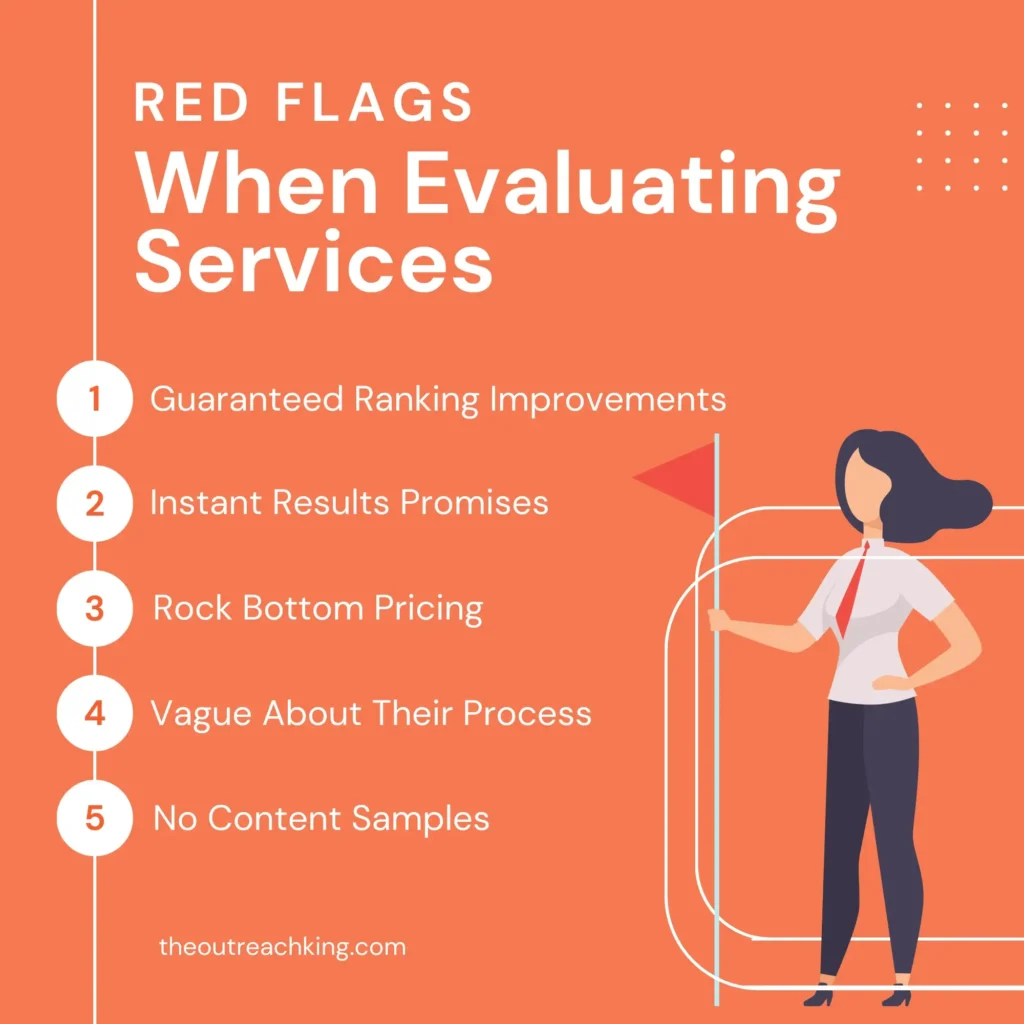
- Guaranteed ranking improvements (no one can guarantee this)
- Instant results promises (quality outreach takes time)
- Rock bottom pricing (under $50 per post is usually low quality)
- Vague about their process (transparency is key)
- No content samples (you need to see their writing quality)
Ready to skip the learning curve? Our white-hat guest posting service has helped
small businesses increase organic traffic by 244% on average.
See if we’re a good fit for your business.
Future-Proofing Your Guest Posting Strategy
Trends Shaping Guest Posting in 2026:
1. AI Detection and Quality Filters: Publishers are using AI to detect low-quality, auto-generated content. Solution: Invest in high-quality, human-written content with personal insights.
2. E-A-T Emphasis (Expertise, Authoritativeness, Trustworthiness): Google’s focusing more on author credentials and content expertise. Solution: Build author profiles and establish thought leadership.
3. Niche Authority Over Broad Coverage: Dominating a specific niche beats spreading thin across topics. Solution: Focus your guest posting on 2-3 core topics maximum.
4. Relationship-Based Outreach: Cold pitching is becoming less effective. Solution: Invest time in relationship building before pitching.
Industry-Specific Guest Posting Strategies
For SaaS Companies:
Target Publications:
- Product management blogs
- Developer communities
- Business productivity sites
- Industry-specific trade publications
Content Angles:
- “How we scaled [specific metric] using [methodology]”
- “The hidden costs of [competitor solution]”
- “[Number] mistakes we see companies make with [process]”
For E-commerce Brands:
Target Publications:
- Industry trade magazines
- Consumer lifestyle blogs
- E-commerce education sites
- Influencer partnerships
Content Angles:
- “Behind the scenes of building [product category]”
- “What [customer type] actually want (spoiler: not what you think)”
- “The [number] trends changing [industry] in 2026”
For Service Businesses:
Target Publications:
- Local business journals
- Industry association sites
- Regional publications
- Professional development blogs
Content Angles:
- “What [number] years in [industry] taught me about [topic]”
- “The biggest mistakes [target customer] make with [service area]”
- “How we helped [customer type] [achieve specific result]”
Not sure which strategy fits your industry best?
Book a free audit call where we’ll analyse your current SEO situation and create a custom guest posting roadmap for your business.
Building Your Internal Guest Posting System
The 90-Day Runway:
Days 1-30: Foundation
- Research target publications
- Develop a content calendar
- Create author bio and headshots
- Build a sample content library
Days 31-60: Relationship Building
- Engage with target publications on social media
- Comment thoughtfully on relevant articles
- Share and amplify publishers’ content
- Connect with editors on LinkedIn
Days 61-90: Systematic Outreach
- Send personalised pitches
- Follow up systematically
- Track responses and feedback
- Refine approach based on results
Monthly Maintenance Tasks:
- Review and update the target publication list
- Analyse competitor guest posting activity
- Monitor brand mentions and link health
- Report on traffic and ranking impacts
- Plan next month’s content topics
Scaling Your Guest Posting Efforts
When to Scale Up:
- Consistent positive ROI from existing efforts
- Organic traffic growth attributable to guest posting
- Strong relationships with 5+ publications
- Clear processes and systems in place
How to Scale Effectively:
- Hire specialists (outreach VAs, content writers)
- Invest in better tools (advanced outreach platforms)
- Expand topic coverage (adjacent industries and interests)
- Increase publication quality (higher DA sites)
- Add content formats (infographics, videos, podcasts)
FAQs
How long does it take to see results from guest posting?
Most businesses see initial traffic within 2-4 weeks of publication. Ranking improvements typically take 3-6 months with consistent effort. The key is persistence – SEO is a marathon, not a sprint.
What’s the difference between cheap and expensive guest posting services?
Cheap services (under $50/post) typically use low-quality sites with little traffic, automated outreach, and poor content. Premium services ($200+/post) focus on high-authority sites, personalised outreach, and quality content creation.
How many guest posts should a small business publish per month?
Start with 2-3 quality posts per month. This allows for consistent progress without overwhelming your budget. Scale up to 5-10 posts monthly once you’re seeing positive ROI.
Is guest posting still effective after Google’s algorithm updates?
Yes, when done correctly. Google’s updates target low-quality, spammy guest posting. High-quality, relevant placements on authoritative sites remain a powerful SEO strategy.
Should I write my own guest posts or hire a service?
If you have the time and writing skills, DIY can work well. However, most small business owners benefit from hiring specialists who understand publisher requirements and have established relationships.
How do I know if a guest posting opportunity is worth pursuing?
Look for: relevant audience overlap, decent organic traffic (1000+ monthly visits), engaged readership (comments/shares), and editorial standards. Domain authority is less important than audience relevance.
What’s the biggest mistake small businesses make with guest posting?
Thinking it’s a quick fix. Guest posting is relationship building and authority development. It takes time, consistency, and quality content to see meaningful results.
How much should I budget for guest posting as a small business?
Start with $500-1000 monthly for 2-3 quality placements. This provides enough activity to see results without breaking the bank. Increase investment as you see positive ROI.
Can guest posting hurt my website’s SEO?
Poor-quality guest posting can hurt your SEO through Google penalties. Stick to white-hat practices: relevant sites, quality content, natural link placement, and editorial oversight.
How do I measure the success of my guest posting efforts?
Track organic traffic growth, keyword rankings, referral traffic quality, brand mention increases, and ultimately leads/sales attribution. Focus on business impact, not just vanity metrics.
Guest posting services for small businesses aren’t just about getting backlinks. They’re about building relationships, establishing authority, and creating sustainable growth.
The businesses that win are the ones that treat guest posting as relationship building, not link manipulation. They provide genuine value, tell compelling stories, and play the long game.
Start small, focus on quality, and be consistent. Your future self will thank you for the visibility, authority, and organic traffic that compounds over time.
Ready to stop being invisible online? Time to get started.